

Ambition
At INSEE, we are committed to upholding human rights principles across all our operations. Setting the standards for the built industry of tomorrow, we prohibit discrimination, ensure fair treatment of employees, and expect the same from our business partners. We engage transparently with communities and customers, continuously improving our human rights practices to create a sustainable future for all our stakeholders.

Human Rights Overview
The Group believes that respect for human rights is the foundation of a sustainable business. Therefore, we aspire to grow alongside society with responsibility and transparency. Our aim is to create value for our stakeholders, with the eventual goal of being the organization that is trusted by all and that is one of the driving forces of sustainability.
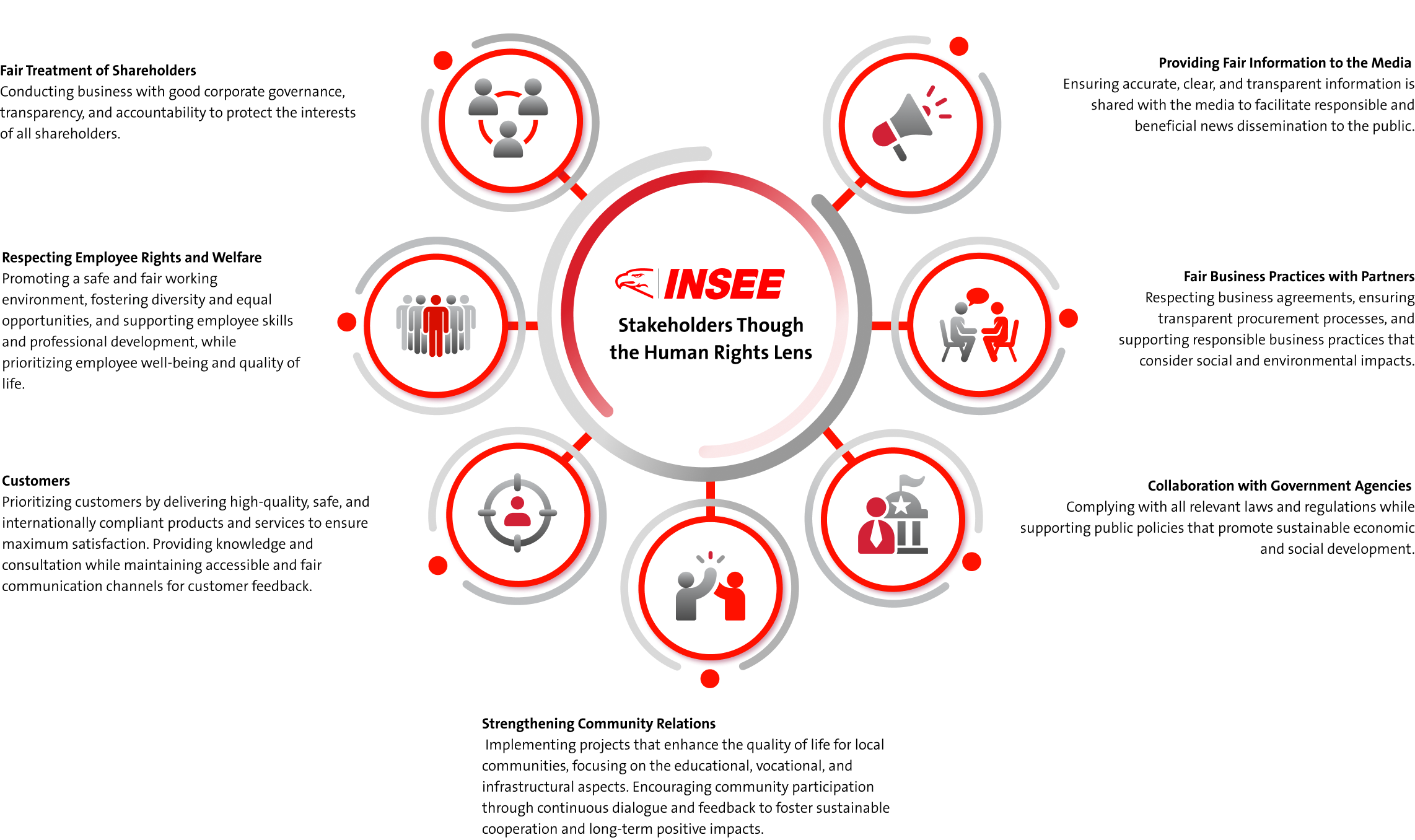
Human Rights: Respecting Rights, Empowering People, and Building Sustainable Communities
The Group, respect for human rights is at the heart of how we conduct business. We believe that treating every person with dignity, fairness, and respect is essential to sustainable growth and long-term value creation. Our commitment extends across our operations, value chain, and the communities connected to our business, including employees, contractors, suppliers, business partners, customers, and local communities.
We uphold fundamental labour rights and maintain a zero-tolerance approach to child labour, forced labour, human trafficking, and any form of modern slavery. We are also committed to creating an inclusive, safe, and respectful workplace free from discrimination, harassment, bullying, and unfair treatment. Employment and people-development decisions are based on merit, qualifications, performance, and business needs.
We respect the principle of equal pay for work of equal value and is committed to fair and non-discriminatory remuneration practices. Compensation is determined based on job responsibilities, qualifications, skills, experience, performance, and other relevant factors, in accordance with applicable labour laws and regulations. SCCC does not discriminate in remuneration. We are ensuring that all employees receive wages that meet or exceed applicable statutory minimum wage requirements.
The Group identifies and assesses salient human rights issues relevant to its operations, business activities, and value chain through human rights due diligence and stakeholder engagement. These include employee rights and fair treatment, non-discrimination, occupational health and safety, responsible treatment of suppliers and contractors, and the rights of communities and other affected stakeholders. We regularly engage with relevant stakeholders to understand their concerns and expectations and use these insights to strengthen our human rights management and mitigation measures.
The Group is also committed to respecting human rights and non-discrimination in accordance with international standards by integrating our Human Rights Policy into the Code of Conduct, while clearly communicating these expectations and policy pertaining to human rights to all stakeholders including employees, suppliers, contractors, and business allies, through various media such as the Code of Conduct, the Sustainable Development Policy which covers human rights matters, and the Responsible Procurement Policy, or the Supplier Code of Conduct and Privacy Policy for Suppliers.
Human rights principles are also integrated into the selection and assessment processes for both existing and prospective suppliers. These processes are conducted fairly and transparently to ensure that suppliers understand and adhere to human rights principles, while supporting the effective prevention and mitigation of potential human rights violations.
Furthermore, the Group provides annual human rights training as an integral part of its Business Code of Conduct training for all employees, targeting 100% coverage. The training reinforces employees’ understanding of the Human Rights Policy, strengthens awareness and prevention of human rights violations, and supports the systematic identification, assessment, prevention and management of human rights risks throughout the work process.
The Company places great importance on creating a safe, respectful, and harassment-free working environment to promote a friendly and fair workplace atmosphere for all employees. The Head of Legal, who also serves as a member of the Screening Committee for cases reported through the INSEE Speak Up whistleblowing channel, plays a key role in ensuring the Company’s compliance with laws, regulations, and the Code of Business Conduct. This role includes providing legal advice and managing sensitive cases involving bullying, harassment, or other inappropriate workplace behavior, and it requires strong expertise in labor law, human rights, and internal grievance management.
Managers and supervisors are trained on their responsibilities for preventing and appropriately handling workplace bullying and harassment as part of the Leadership Program conducted by the Human Resources Department. The training covers receiving and responding to reports, maintaining confidentiality, preventing retaliation, and appropriately escalating and addressing reported cases in accordance with the Company's policies and procedures.
Under the Company’s Whistleblowing Policy, any incident or complaint reported through INSEE Speak Up must be reviewed by the Screening Committee. The Committee is responsible for conducting a thorough, impartial, and confidential investigation, and for recommending appropriate corrective and preventive actions to management. The Company is committed to fostering an organizational culture of mutual respect, free from discrimination, bullying, and harassment of any kind, to ensure that all employees are treated equally and with dignity in the workplace.
We work closely with local communities to create positive and lasting social impact through education support, scholarships, community development programs, and stakeholder engagement. We also encourage employees and stakeholders to raise concerns about potential human rights violations or inappropriate conduct through the Company’s established reporting channels. Reports are handled fairly, confidentially, and without retaliation, with appropriate corrective actions taken when necessary.
Respecting human rights is an integral part of our business responsibility. We remain committed to continuously strengthening our policies, awareness, governance, and improving our processes. We also engage with stakeholders to identify and address relevant human rights issues through initiatives such as labor union meetings and community engagement visits. These efforts help ensure that human rights are respected and protected throughout our operations and value chain.
The safety, health, and well-being of every person are central to our operations. We continuously strengthen our occupational health and safety practices to protect employees, contractors, visitors, and surrounding communities. SCCC is committed to preventing excessive working hours by regularly monitoring employees' working hours and overtime and implementing appropriate measures to manage workloads, support employee well-being, and promote a healthy work-life balance.
At the same time, we respect employees’ rights to freedom of association and collective bargaining in accordance with applicable laws, supported by open and constructive dialogue with employee representatives and labour unions.
We invest in learning, capability building, leadership development, and career opportunities to help our people grow and realize their full potential. Beyond our own organization, we expect suppliers, contractors, and business partners to operate responsibly and uphold the same principles of human rights, ethics, and fair labour practices that guide our business.
Community Rights and Participation in Mining Operations
The Company's operations are located in Thap Kwang Subdistrict, Kaeng Khoi District, Saraburi Province, where there are no Indigenous Peoples as defined under IFC Performance Standard 7. The area is instead surrounded by local communities residing around the Company's operational sites. Nevertheless, the Company respects the human rights of surrounding communities, including their rights to access resources, maintain their livelihoods, and enjoy their quality of life, in accordance with the Company's Sustainability Policy and the United Nations Guiding Principles on Business and Human Rights (UNGPs).
The Company provides information to and seeks feedback from local communities prior to initiating new projects or expanding operational areas. This is conducted through public consultation processes required under the Environmental Impact Assessment (EIA) process, as well as community consultation meetings conducted as part of the mining concession application process, in accordance with the Ministry of Industry Notification on the Criteria and Procedures for Community Consultation in Areas Applying for Mining Concessions B.E. 2561 (2018), issued pursuant to Section 56 of the Minerals Act B.E. 2560 (2017). The Company follows a community participation approach throughout the project lifecycle, from planning and implementation to evaluation and benefit sharing.
For this reason, the Company places importance on community participation throughout the entire mining life cycle, from before operations begin, during operations, and through to the post-mining phase. It also maintains a consistent process for communication, gathering feedback, and monitoring outcomes through the Evening Visit program.
In addition, the Company continuously builds relationships and trust with local communities through ongoing engagement activities. These include the Evening Visit program, under which the Company regularly visits communities surrounding its operational areas each month to listen to their views, suggestions, and concerns, as well as monthly meetings of the Subdistrict Committee. Community feedback and concerns are systematically recorded and followed up. The Company also provides the INSEE Speak Up channel, which enables community members to raise concerns and submit complaints at any time.